Museum Houses of Goa a Indo Portuguese Architecture
 We in Goa have a strange but novel history and that is, we are part of
the first sustained encounter between the East and the West.Though we
have a long and rich history from times immemorial and much before the
arrival of the portuguese,this encounter produced a culture and architecture
which is unique.This museum showcases the houses which were the prime
expression of the goan identity.
We in Goa have a strange but novel history and that is, we are part of
the first sustained encounter between the East and the West.Though we
have a long and rich history from times immemorial and much before the
arrival of the portuguese,this encounter produced a culture and architecture
which is unique.This museum showcases the houses which were the prime
expression of the goan identity.
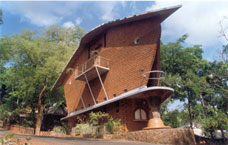
The museum is built as a traffic island in Torda,Salvador-do-Mundo,Goa.Strangely enough it is in the shape of a triangle and resembles a ship.Viewed from the outside it is a mystery,but as you begin your visit,it slowly unfolds its charms.
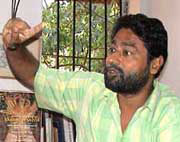
WHAT is so special of a Goan house? "When the Portuguese colonized Goa," architect Gerald da Cunha says, "they brought in their own architectural designs and lifestyle to influence the already strong culture and architecture that prevailed here. As a result of the amalgamation, an entirely new thing emerged. What you see in Goan houses, you don't see in Portugal, or elsewhere in the world." The highly creative architect claims that it is "our own Goan style. Goans, who were people who were converted, were looking for a new identity, and thus embarked on the experiment in architecture, to produce something unique and unseen anywhere in the world". When asked about how he has conceived the museum concept, he says that;being an architect it is my responsibility to document the architecture as a local, who has thrived in this place"picturesque Salvador do Mundo village in Bardez. So he created a ship-like structure to house all the goodness in Goan architecture, which would otherwise be lost.It is very important for us to document it, to enjoy it. At the first level, he depicts Goa in the context of the world, and then goes on to display the wealth of Goan architecture on the first floor. On the second floor, delves into the details of Goan architecture: the doors, windows, railings, construction material, furniture, etc. And on the top he shows the "final amalgamation". And the whole story is being unwound here with a slide show every evening. Despite being located away from the Panjim-Mapusa highway, nearly 1000 people have already visited the place so far. The bulk of the visitors have been students of architecture, nearly 300 of them have been from outside Goa, drawn by the fame that has gathered around Gerard by virtue of his phenomenal success as an exponent of natural architecture as well as the impressive designs he has produced for various institutions including townships. He says that it is a mixed bag of visitors otherwise, some big personalities visiting occasionally, like the American Ambassador did recently along with his family.
Aboard the "Houses of Goa", the ambience is enchanting, enjoyable. There is soft music backing up Gerard's detailed description of each item, as only someone who is so deeply engrossed in things Goan can do so. On the walls hang pictures of imposing, important buildings in the world on one panel and beside is another panel with equally important Goan monuments, showing when they were built, so that one can compare what was being built while the Se Cathedral was being built in Goa somewhere else in the world. Five-hundred-year-old pictures of Goa collected from various sources worldwide, rare postcards of Goa dating back to 1900, giving an exclusive picture of what Goa and its cities looked like a century ago. There are maps, architectural designs and plans of some very old houses like Mario Miranda’s, with a bit of its history and location of each house. Having finished seeing all that's on the wall, around the round pillars, you approach the computer systems where you can click on to the documentation of Goa's history right from the day the Portuguese landed on the Anjediva island. The history of Goa from the pre-historic times, the Bhoja empire, the ancient Rashtrakutas, is also found. Moreover, there is an album of large panels giving all the pictures showing the colour, flooring, doors and windows, old railings, etc of a typical Goan house. Rare pictures of the first things in Goa like the first telephone The impressive collection is consistently burgeoning with people being gracious enough to loan their rare heirlooms and Gerard hoping that more people would follow the example to enhance the exclusive ambience of Goa’s unique museum “Houses of Goa”. |
 Like a modern-day
Noah setting out with his special arch with a specimen of every
Goan tradition, Gerald da Cunha takes you on an eventful voyage,
showing you "Goa in the context of the world, the wealth of Goan
architecture and the details of various elements" that make Goan
houses so special. A painstaking collection of doors, windows, a
rare hat stand, old French doors from a house in Margao built in
1917, old tiles from late nineteenth century, old china mosaic patterns
of different houses, how mud walls are made, how shells are recovered
from the river, a glass tile, the dressed laterite, 16th and 17th
century tiles imported from Europe, old terracotta tiles, religious
pictures, altars, statues, etc.
Like a modern-day
Noah setting out with his special arch with a specimen of every
Goan tradition, Gerald da Cunha takes you on an eventful voyage,
showing you "Goa in the context of the world, the wealth of Goan
architecture and the details of various elements" that make Goan
houses so special. A painstaking collection of doors, windows, a
rare hat stand, old French doors from a house in Margao built in
1917, old tiles from late nineteenth century, old china mosaic patterns
of different houses, how mud walls are made, how shells are recovered
from the river, a glass tile, the dressed laterite, 16th and 17th
century tiles imported from Europe, old terracotta tiles, religious
pictures, altars, statues, etc.
If the house possesses a fairy-tale look within, a view outside is still more enchanting. The beautiful foliage, in which sing all sorts of lovely birds, and the three houses in natural architecture that Gerard has build virtually in the midst of nowhere, deep in a pristine valley. He has been collecting the things for several years. “It is going to grow”.The germ of the idea is 5- or 6-year-old. I decided that I will have a building to house this collection, since I had this piece of land, which is ideal. I made in an the design of traffic island. Architecturally, he would call it a 'most modern of modern buildings'. There is nothing traditional about its architecture But it is nice sometimes to display traditional things in a modern building," he says. The shape of ship emerged, because the site was like that. Now for people it looks like a ship, from somewhere else it appears like a big bird, from another angle on the hill it looks like a rocket about to take off. "My chance as an architect to do an interesting building." "Goa is a land of colour and spice, and the Goan house is very special." Gerard's landmark museum provides a ringside view of it. |
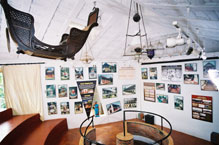 Climb
the winding steps to the theatre upstairs, to see rare ancient lamps
and a machila, and with a seating arrange for about 100 people.
Here Gerard conducts a slide show presentation, with an adaptable
screen, taking you on an architectural tour right to the earliest
mud house.
Climb
the winding steps to the theatre upstairs, to see rare ancient lamps
and a machila, and with a seating arrange for about 100 people.
Here Gerard conducts a slide show presentation, with an adaptable
screen, taking you on an architectural tour right to the earliest
mud house.